The December Call Centre – An Unspoken Truth
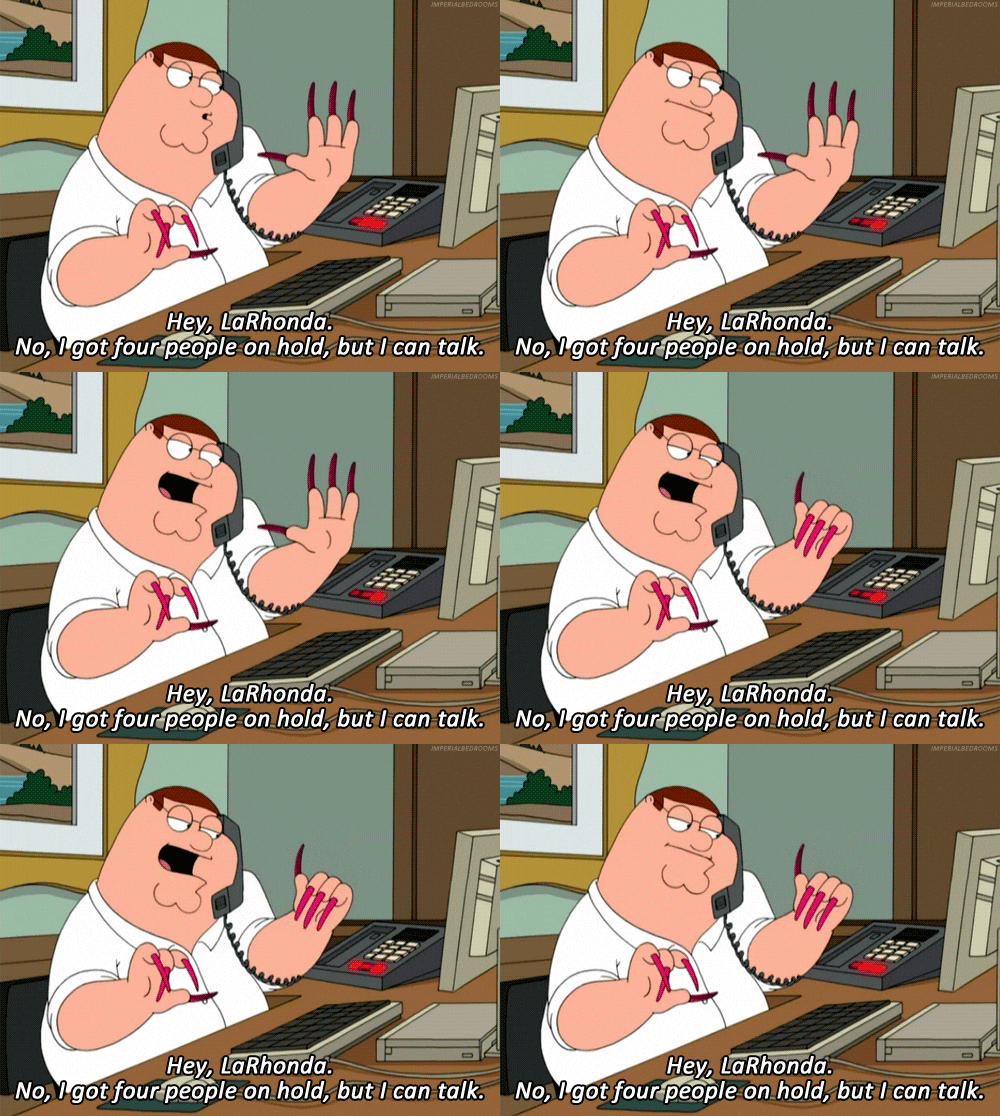
While the world slips into the holiday spirit—office parties, early knock-offs, bonuses, and long-awaited family time—call-centre employees enter their most hostile season of the year. The phone lines swell with panic, impatience, and entitlement. Year-end deadlines pile up. Systems strain under the pressure of rapid mouse clicks and angry typing. And somewhere between the “urgent escalations” and the “please hold,” there is a slow countdown of how many more calls and emails I can survive before I mentally collapse.
Welcome to The December Call Centre.
Let me introduce you to the staff:
Gregory
Gregory is the golden child—the star of the year. The man has never been late a single day in his life. He logs in on time, logs out on time, and is never two seconds late returning from lunch or break. You could set a clock by his discipline.
His desk is so immaculate you could lick soup off it—and it would probably taste cleaner than the office microwave ever has. He throws in overtime like it’s a competitive sport, chasing performance metrics the way athletes chase medals.
Need help? Greg is already walking toward your desk before you even finish the sentence.
System glitching? He knows the workaround.
Customer wants a supervisor? Greg will take the call.
Another department drowning? Greg will volunteer before their manager even sends a group email.
He is the unofficial departmental backbone—the guy management silently prays never resigns. When he’s off sick (on the rare occasion his immune system allows it), the floor spirals. Suddenly supervisors are “monitoring the situation.” Team leaders start sending out panicked Teams messages. Everyone else just realises how much they actually rely on him.
He sets the status quo so high that HR should charge entrance fees. Then, once everyone finally catches up, he resets it—because the old one has become redundant, mediocre, and too easy for his liking. Greg is the standard, the benchmark, the legend.
But even legends crack in December. Let me tell you what happened to Gregory.
He finally decided to take his first ever December leave—a romantic getaway with himself, his kids, and his partner to Paris and Italy. Everything planned with Greg-level precision: flights booked months in advance, leave requested in July, restaurant reservations secured, activities scheduled, and even a babysitter arranged so he and his partner could reconnect. Classic Greg—efficient to the bone.
A few days ago, he approached his Team Leader to gently remind her about the dates.
Her face twisted with that familiar expression of manufactured confusion.
“Leave? Greg? Did you submit anything?”
Greg calmly reassured her and pulled up the email thread, the confirmations, the digital paper trail that only he could maintain so neatly.
Her response? Cold. Quick. Corporate.
“Oh no, Greg… unfortunately we can’t accommodate those days. Nathan and Kiki are already taking leave, and with year-end coming up, we’re going to be short-staffed.”
Greg’s heart dropped faster than a brick in a lake.
The breath punched out of him.
His stomach clenched into a knot as he tried to piece together how months of planning could evaporate in a single sentence.
He walked away, devastation carved into his expression—a mix of disbelief, anger, and heartbreak. Under his breath, he cursed quietly, the way only a truly betrayed employee does.
And yet… you know what Greg did?
Despite every raging emotion, despite the wasted money, the ruined plans, the shattered anticipation—Greg returned to his desk, sat down, adjusted his headset, and swallowed the lump in his throat.
The phone rang instantly.
“Welcome to…” he began, forcing a smile into his voice, hands slightly trembling, but his voice unshaken, as if nothing had happened at all.

Kiki
If Gregory is the engine, Kiki is the feather floating somewhere above it—light, effortless, and entirely unbothered by the chaos below.
Where Greg arrives ten minutes early, Kiki strolls in ten minutes late… with an iced coffee.
Every. Single. Day.
Not rushing.
Not apologising.
And not even pretending to care.
Her headset? Somewhere in her bag.
Her notebook? Missing since May.
Her screen? Often on the home page because as she always says, “I’m good at what I do!”
Her favourite phrase?
“I’ll check it now-now,” which, in Kiki-language, “Now” means later in the day and “Now-Now” is a suggestive time frame between to tomorrow and never.
The thing is: Kiki isn’t incompetent. Not at all. She’s actually talented.
Quick thinker. Smooth talker.
Knows the system—when she feels like it.
The problem is she simply… does not care.
When customers scream, she lowers the volume and continues typing her grocery list and occasionally throws in an “I understand”.
When deadlines loom, she asks, “Is this urgent-urgent or urgent?”
When supervisors remind her about her targets, she nods with the warm smile of someone who forgot the conversation the moment it ended.
Her attendance record looks like a national lottery draw—random digits everywhere.
Her leave requests? Endless.
Her medical certificates? Suspiciously handwritten.
But somehow—somehow—everyone loves Kiki.
Her laugh is infectious.
Her chaos is entertaining.
And her stories about why she’s late are so elaborate they deserve an award.
Management? They’ve given up trying to predict her. She is the human equivalent of a weak WiFi connection: unpredictable, unreliable, but still functioning—just barely.
And what is Kiki like in December?
Her calls? Short.
Her breaks? Long.
Her morale? Untouched by the world.
While everyone else suffers under the December pressure cooker, Kiki glides through the chaos with the serenity of someone who already mentally clocked out on the 1st of the month.
And you know what?
Despite her complacency, despite her disappearing acts, despite her utter lack of urgency—Kiki will walk out of December just as stress-free as she walked into it.
Because Kiki mastered something most people never do:
She refuses to be destroyed by a job that doesn’t pay her enough to care.

Nathan
If the call centre were a ship, Nathan would be the sailor who can steer through a storm with one hand—because the other hand is holding yesterday’s hangover.
Nathan is the kind of agent who performs exceptionally well, but only because he’s running on a cocktail of caffeine, nicotine, and the remnants of last night’s bad decisions. He arrives every morning with sunglasses, a water bottle the size of a newborn child, and the unmistakable scent of… “rough evening.”
He rarely speaks in the mornings. He just sits, boots up his computer, adjusts his headset, and stares at the screen with the look of a man fighting both his demons and heartburn.
But when the calls start?
Nathan transforms.
He becomes sharp. Smooth. Charming.
A customer could be sobbing, screaming, threatening legal action—Nathan will calm them down in under two minutes. His voice is warm and steady, the kind that says, “Everything is under control,” even if his liver is filing HR complaints.
Management adores him but sees him as weird.
Why wouldn’t they?
Nathan hits targets while half-alive.
Nathan solves complex queries in record time. Negligent only when he is having a booze frenzy.
But the thing is—everyone knows.
Everyone knows.
They know that when he suddenly goes quiet, he’s fighting back the consequences of last night.
They know the difference between “Nathan at 40% battery” and “Nathan after a staff function,” which usually requires a wellness check.
He spends most of December whispering “I’m too old for this” under his breath.
He keeps a secret stash of Energades in his drawer, right next to his headache tablets and a bottle of gum he chews like it’s oxygen.

Maseko
On paper, Maseko is still an employee.
In reality, he is a ghost.
No one knows the exact moment he snapped, but rumour has it he mentally checked out sometime in July — specifically during a team huddle where Samantha said, “We’re like a family.”
He has not recovered since.
He answers calls, but only the bare minimum. If enthusiasm were measurable, he’d be in the negatives. His responses are slow, soft, and delivered with the energy of someone reading a eulogy for their own career.
His best skill?
Looking busy while doing absolutely nothing.
He always has a spreadsheet open.
Not because he’s working on it — it’s just camouflage.
If you stare long enough, you’ll realize the numbers haven’t changed all day.
He has perfected the art of:
- Nodding in meetings without listening
- Smiling politely while not absorbing a single word
- Doing enough work to avoid HR, but never enough to attract responsibility.
His soul left the building months ago.
His body continues showing up because rent doesn’t care about vibes.
December reveals his superpower:
He has no expectations.
No workplace dreams.
So, it is quite expected of him in December to not voice out anything.
You might not notice when he is at work or not. You can’t break someone who broke months ago.

Tanya
Meet Tanya Mokoena, Team Leader by title, emotional support sponge by default.
Tanya didn’t choose leadership; leadership chose her because she was the only one who didn’t say “no” fast enough. And now she spends her days juggling:
- Agents who cry in the bathroom
- Angry customers demanding refunds she has no authority to issue
- Management’s unrealistic expectations
- HR breathing down her neck
- And reports… so many reports
She produces more spreadsheets in a week than NASA did during the moon landing.
But December, oh no, December is unholy.
December exposes every crack in the call centre’s foundation — and unfortunately, Tanya has to plaster every single one with her remaining sanity.
How December destroys her:
1. Every agent becomes a ticking emotional time bomb
Greg is silently falling apart because of leave drama.
Kiki is secretly job hunting.
Nathan smells like a brewery but performs better than most sober agents.
Maseko is spiritually dead.
Some days, Tanya feels less like a team leader and more like the custodian of 15 malfunctioning souls who require both therapy and exorcisms.
2. Customers are angrier
Christmas shopping, closed offices, year-end panic, financial anxiety — it all pours into the call centre like a tsunami.
Agents escalate everything.
- “Tanya, the customer wants a supervisor.”
- “Tanya, this person asked for you BY NAME.”
- “Tanya, the system froze again!”
- “Tanya, the customer says he’ll come to the office to see you personally.”
By mid-December, she starts hiding behind partitions when she hears the words “Supervisor call.”
3. Management treats her like a miracle worker
Management emails her things like:
- “Please ensure zero hold time today.”
- “We need daily progress reports on the weekly report.”
- “Please remind your team of their targets.”
- “We need 10 volunteers for overtime tonight.”
Volunteers?
In December?
She might as well ask crocodiles to become vegetarian.
Last Tuesday afternoon, she hit her limit.
The queue hits 89 calls waiting.
Greg is on the verge of tears.
Maseko is taking a “longer-than-usual” walk to the kitchen.
Samantha the supervisor is micromanaging so hard she’s basically deleting productivity by existing.
IT is “investigating the outage.”
And management is asking why targets aren’t being met.
Then an escalated call comes through.
A customer screaming about something that isn’t even their department’s problem.
Tanya takes the call.
She listens, explains, apologises, promises to escalate, fixes what she can, diffuses, reassures, and closes the call kindly.
Then she mutes her mic…
Lowers her head…
And cries silently at her desk.
Not dramatically.
Not loudly.
Just a quiet, exhausted release from someone who hasn’t had a real break in months.
And like the professional she is, she wipes her face, takes a deep breath, and says:
“Next call.”
Her December Resilience
Tanya may be collapsing inside, but December is where she becomes a soldier.
She protects her team from management.
She protects management from her team.
Protects customers from chaos.
And protects chaos from spreading.
By the time December ends, she’s beyond drained — but somehow, she’s still standing.
Every January, she swears she’ll leave.
Every year, she stays.
Because deep down, she cares.
And caring, in a call centre, is both a superpower… and a downfall.

Samantha
Sam didn’t climb the corporate ladder—she accidentally tripped upwards.
People still debate how she became a supervisor. Some say it was nepotism. Others claim she once impressed upper management by using “synergy” and “holistic outcomes” in the same sentence.
Her entire leadership philosophy can be summed up in one phrase:
“If I don’t know what I’m doing, NO ONE ELSE MUST KNOW WHAT THEY’RE DOING EITHER.”
She micromanages with religious commitment. She appears behind agents like a haunted presence, staring at their screens like she’s reading hieroglyphics and makes sure that she squeezes every millisecond of work-time from each agent. Her feedback always sounds like corporate inspirational quotes stitched together by a malfunctioning robot:
- “Improve your synergy with the customer’s emotional journey.”
- “Be more proactive with proactive follow-through.”
- “We need alignment on your alignment.”
No one knows what any of that means. Not even Sam.
Her weakness? Actual work.
Whenever something technical breaks, she goes into full panic, eyes wide, voice trembling:
“Just… log a ticket!
The numbers are not adding up?
She shifts the blame to every other factor besides her actual incompetence and lack of foresight.
But Sam isn’t malicious. She’s scared.
Every day she wakes up with the fear that today is the day someone will say:
“Sam… do you actually know what your job is?”
So she compensates by controlling everything she can.
Hovering. Over-explaining. Monitoring call times like a detective on a crime show.
And the team? They don’t mind—because if they push hard enough, do enough, prove enough…
Sam will eventually get promoted up and out of their lives.

The December Call Centre: A Survival Challenge, Not a Month of Celebrate
December in a call centre is not a month.
It’s a pressure cooker.
A battlefield.
A psychological obstacle course disguised as “festive season.”
While the world wraps gifts, they wrap up escalations.
Families gather for braais and laughter, they gather in boardrooms to discuss why hold time “unexpectedly increased.”
While society slows down…
They speed up to an inhuman pace.
And inside this chaos, each person fights their own private war:
- Greg carries the weight of perfection until it crushes him.
- Kiki floats through December with careless luck and questionable attendance.
- Nathan drinks his stress but still outperforms half the floor.
- Samantha micromanages because she’s terrified of being exposed.
- Zoe works like a hero but secretly plots her escape.
- Maseko gave up months ago, and the job never noticed.
- Tanya, the overworked Team Leader, holds everyone together with duct tape, Excel sheets, and the last shreds of her sanity.
These are not characters in a story.
They are the people who answer calls you don’t want to make.
The people who carry the emotional burdens of customers, management, and life itself — often all at once who are expected to be calm, polite, knowledgeable, efficient, and endlessly patient no matter what is thrown at them.
And every December, they give far more of themselves than anyone outside those walls will ever understand.
Because December in the call centre is not about Christmas cheer.
It’s about survival. Surviving the queues, the panic, the pressure, the blame, the micromanagement, the impossible expectations, the emotional labour no one pays for.
And when the last call of the year finally ends, and the lights switch off, and the headsets rest on their hooks…
There is a moment.
A small, quiet breath.
A reminder that they made it.
Bruised, tired, emotionally starved — but alive.
That is The December Call Centre.
Not glamorous, not grateful and definitely festive.
But real.
Raw.
Human.
A place where ordinary people endure extraordinary pressure — and still show up again tomorrow.
Because someone has to.